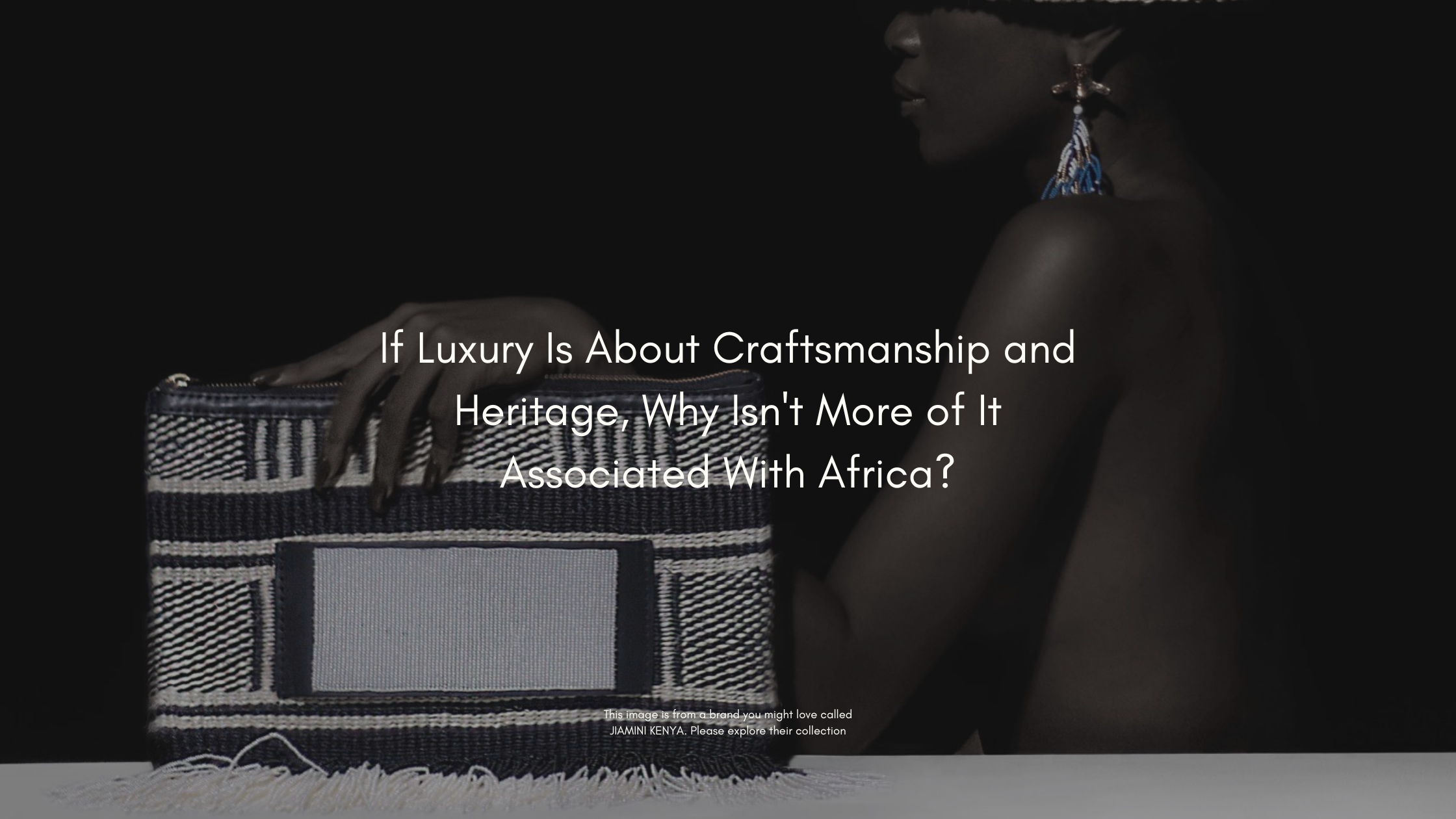
If Luxury is about craftsmanship and heritage, why isn't more of it associated with Africa?
Luxury has long been associated with certain countries, cities, and labels. Paris, Milan, London, Geneva.
When people think of luxury fashion, hospitality, jewelry, design, or travel, their minds often travel to Europe before they travel to Africa.
But why? Because when you strip luxury back to its foundations, the disconnect becomes difficult to explain.
The world’s leading luxury groups consistently describe luxury through words such as craftsmanship, heritage, culture, artistry, creativity, savoir-faire, authenticity, and the passing of knowledge from one generation to the next.
These are the very qualities that define many African communities, traditions, and creative industries.
So where does the disconnect come from?
What Luxury Says It Values
I have spent years studying the luxury industry and I am still studying it, but this time, through a lens of culture and sustainability rather than as just another curious fashion student.
Through this time, a clear pattern has emerged.
Luxury brands invest heavily in preserving traditional skills. They celebrate artisans, protect heritage, support artists and they tell stories about place, culture, and identity.
Groups like LVMH have built entire ecosystems around this understanding, recognising that the value of luxury is not only in the product but in the cultural and human stories behind it.
The most respected luxury houses understand that meaning is what creates desire and not products alone.
In my current luxury studies, I am constantly reminded that handbag becomes valuable because of the story behind it, watch becomes valuable because of the expertise required to create it, a destination becomes desirable because of its culture, people, and sense of place.
Which makes it increasingly difficult to understand why Africa remains on the margins of so many luxury conversations.
The African Contradiction
Africa is home to centuries of craftsmanship. From handwoven textiles and beadwork to leatherworking, basketry, jewelry making, architecture, gastronomy, music, storytelling, and traditional construction techniques, the continent is rich in the qualities luxury claims to celebrate.
Across Africa, communities continue to preserve knowledge that has been passed down through generations.
Many luxury houses invest heavily in preserving traditions that remain alive across many African communities today.
Yet products and experiences from Africa are often placed in categories such as “craft,” “ethical,” or “artisan” while similar products from elsewhere are labeled “luxury.”
This raises an uncomfortable but necessary question:
Have we become conditioned to associate luxury with geography rather than values?
Luxury Beyond Fashion
This conversation is not only about fashion; it naturally extends into hospitality, travel, design, and lifestyle, where the idea of luxury takes on a deeper meaning. A luxury hotel, for example, is not defined by imported marble alone, but by its ability to create a true sense of place, something that feels grounded and intentional. In the same way, a luxury dining experience goes beyond expensive ingredients and is instead shaped by quality, story, and the connection it creates. A destination becomes memorable not because it resembles everywhere else, but because it offers something that could only exist there. This is exactly where Africa holds extraordinary potential, offering something that is becoming increasingly rare in today’s world: authenticity.
The Rise of a New Luxury Narrative
Fortunately, the narrative is changing. Designers such as Thebe Magugu, Laduma Ngxokolo, Loza Maléombho, Sindiso Khumalo, Lisa Folawiyo, and many others are proving that African creativity belongs in global luxury conversations. Across hospitality, there is a growing appreciation for locally sourced ingredients, indigenous architecture, community-based experiences, and cultural immersion, while in travel, more people are seeking meaningful experiences rather than standardized ones. In design, craftsmanship is once again becoming desirable, and the qualities that have always existed across Africa are becoming increasingly relevant to the future of luxury.
Perhaps We Are Asking the Wrong Question
Maybe the question is not whether Africa can produce luxury, but why so many people still struggle to recognize it when they see it.
If luxury is truly about craftsmanship, heritage, artistry, culture, authenticity, and human skill, then Africa should not be trying to fit into existing definitions of luxury.
It should be helping redefine them.
“If luxury is measured by craftsmanship, heritage and culture, then Africa has never been on the outside looking in.” – Belinda Atieno


No responses yet